Not long after King Edward IV died after a three week illness in 1483, an enduring mystery tinged with wickedness took place in London. 12 year old Edward V, King of England and 9 year old Richard of Shrewsbury, Duke of York, were Edward IV’s only sons and rightful heirs to the throne. Considered too young yet to rule, they were housed in the Tower, under the protection of their uncle, Lord Protector Richard, Duke of Gloucester.
This was supposed to be for just a short while so as the 12 year old Edward V could mature before his coronation as King. A date for it had already been set for said event. But the coronation would never take place and both boys would vanish without a trace.
Initially, the coronation was postponed by their uncle when it was claimed that the boys were illegitimate heirs to the throne. King Edward IV’s marriage to their mother Elizabeth Woodville was declared void, as he had a pre-marriage contract written out with Lady Eleanor Butler. The two youngsters were now to be housed indefinitely in the Tower as Parliament discussed and debated upon the right course of action to take in such a scandalous event.
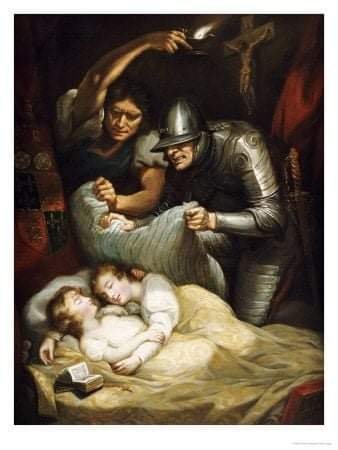
Their father’s brother the Duke of Gloucester duly took the throne for himself, as King Richard III, but the boys disappeared without a trace. It has never been discerned what happened to the Princes, but it’s historically been believed that they were murdered – specifically smothered in their sleep by James Tyrell, so their uncle could ascend to the throne himself. Thomas More penned a controversial account of the event, which he claimed was given to him by eyewitnesses.
“Richard’s men went into the Tower of London bedchamber in the middle of the night, keeping down by force the featherbed and pillows hard unto their mouths, that within a while, smothered and stifled, their breath failing, they gave up to God their innocent souls.”
Many contemporary dignitaries pointed the finger of blame at King Richard III, as did Shakespeare in his plays. Support for King Richard III waned even further when it was rumored that he had killed his Queen Anne Neville, in order to marry his niece, Elizabeth, daughter of Richard IV. In the years that followed the disappearance, a number of men came forward claiming to be either Edward V or Richard, never with any proof to their claims.
Then, in 1674, almost 200 years after their last sighting, workmen made a grisly discovery buried 10 feet deep under a staircase that was demolished for renovation in the Tower; two small human skeletons enclosed in a box. Without any such thing as DNA testing way back then, it could not be proven who the bones belonged to, and whether or not they solved the century’s old mystery. Buried at such a depth it’s possible that the bones were Roman. But the general belief, which persists today, is that they are the bones of the two brothers, who were killed off by their power hungry uncle. The remains which were found partially covered in velvet – perhaps an indication of aristocracy – were re-buried by King Charles II at Westminster Abbey.
As for Richard III, his stay as King would be short lived. He was dead within two years, slain in battle by allies of Edward IV who always believed he had done the dastardly deed. He remains the last King of England to die in battle. The allies had hoped to rescue the brothers from the Tower.
In 1933 the bones of the youngsters were examined by anatomist Professor William Wright and dental expert Lawrence Tanner. It was concluded that the age of the remains corresponded closely to that of the missing Princes. However, the roughhousing approach to the examination has been much criticized and adequate testing to determine the sex of the remains was not conducted.
Incredibly, more than 500 years later, in a car park in modern day Leicester, an archaeological dig uncovered the bones of King Richard III. Using radio carbon dating and mitochondrial DNA from one of his descendants, the skeleton was identified. Despite repeated requests, the same technique has of yet not been permitted to be carried out on the potential royal remains of the boys. While many modern historians are in agreement with Richard III being the likely culprit, without permission to exhume the remains by Westminster Abbey, the malicious medieval mystery regarding the fate of the Princes of the Tower prevails.
 Bash School Of Thought